 Wallabout Insights
May 5, 2026
Ambient push: one-to-one messaging that meets users in the moment
Introducing Ambient Push from TrailGuide: an agentic, easy-to-activate push model that learns when users engage and optimizes for key behavior moments.
Introducing Ambient Push from TrailGuide: an agentic, easy-to-activate push model built for one-to-one messaging. It is not a blast and it is not a fixed schedule. It adapts to each user’s engagement rhythm and nudges them at the moments where behavior is most likely to move.
Think of it like a smart coach. The system learns when someone usually works out, identifies when they are drifting, and sends a timely nudge designed to produce a specific outcome.
How we model on top of existing data (without ripping anything out)
Ambient push works best when it sits on top of centralized, modeled data. The good news is you typically already have most of what you need. We model on top of your existing warehouse or analytics tables, standardize the key events, and derive a small set of traits that make timing and targeting reliable.
- Normalize events: workout_started, workout_completed, pricing_viewed, feature_used
- Unify identity: tie anonymous browsing to logged-in behavior when possible
- Derive traits: preferred engagement hour, momentum score, upgrade intent, support risk
- Define moments: what “success” means for the nudge (second workout, streak, upgrade)
Delivery through existing push tools (example: OneSignal)
We do not replace your push provider. We use customer engagement platforms like OneSignal as the delivery mechanism, and keep the decisioning logic in our orchestration layer. That means you can keep your existing infrastructure, templates, and reporting while getting one-to-one timing and measurable lift.
- TrailGuide determines who should be nudged, when, and with which message variant
- OneSignal delivers the push notification using your existing app setup and tokens
- Events flow back to the warehouse so we can measure the optimization moment
- Holdouts remain consistent across pushes, email, in-app, and product experiments
Framework
The Ambient Push Loop
Detect → Decide → Deliver → Measure → Adapt
WallaboutDetect
Learn each user’s engagement window from real product behavior, not assumptions.
Decide
Select the next best nudge based on intent, momentum, and safety guardrails.
Deliver
Send through push (or any channel) with quiet hours and frequency caps.
Measure
Optimize against a real moment: workout completed, feature used, upgrade, etc.
Adapt
Update timing and content based on what actually changes behavior.
Prove lift
Use holdouts so you can separate “users would have done this anyway” from impact.
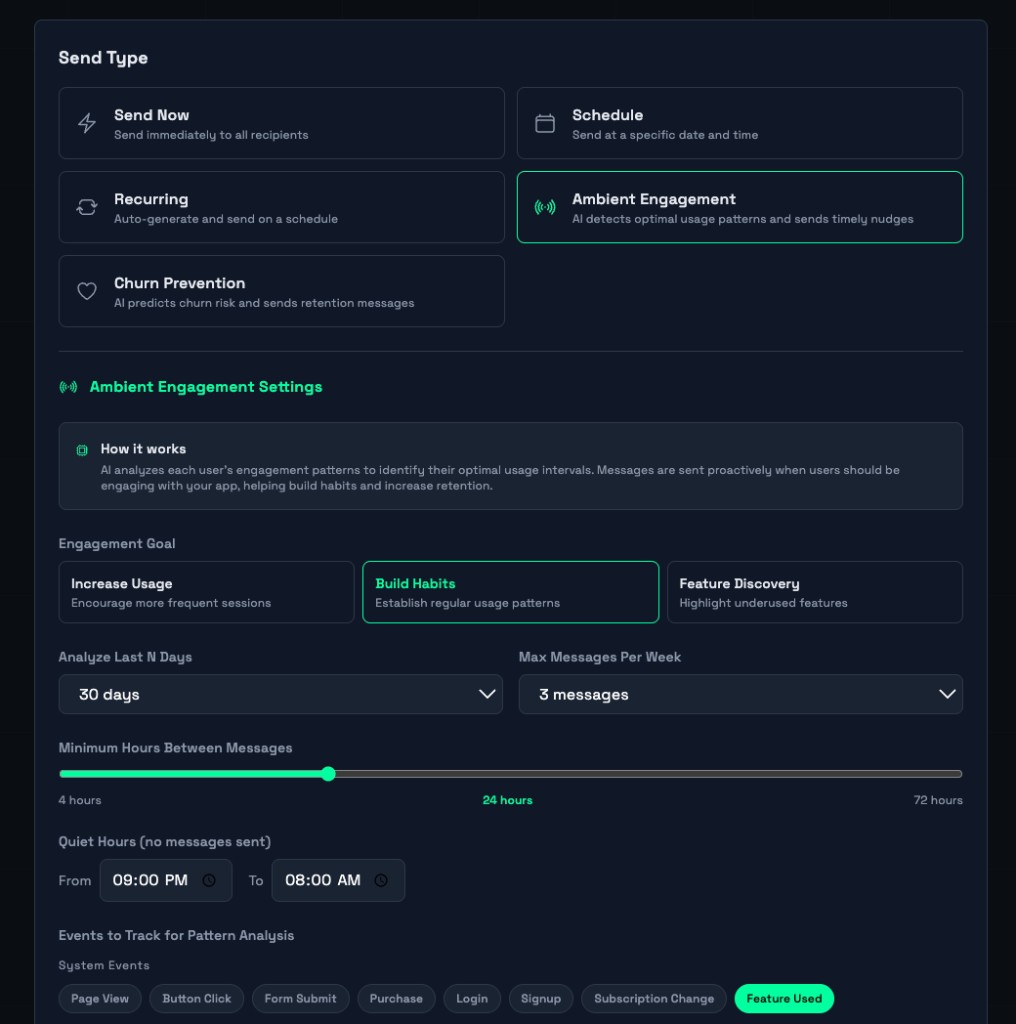
Example: TrailGuide ambient engagement settings
Here is how we build this in TrailGuide. The system is configured around the engagement goal, lookback window, frequency guardrails, and the events that define “pattern analysis.”
Workout app example: what we optimize for
For a fitness app, the “optimization moment” is not the click. It is the moment that predicts retention and value. Ambient push is built to optimize for that moment.
- Build habits: second workout completed within 72 hours of signup
- Increase usage: maintain a 3+ day streak week over week
- Feature discovery: use a new feature that correlates with retention (example: saved plan or favorite workouts)
- Monetization: upgrade from trial to paid after hitting a value threshold (example: 3 completed workouts)
What data you need centralized
Blueprint
Ambient push data blueprint (workout app)
Signals, warehouse tables, and prompts that make ambient timing possible.
WallaboutSource systems (generic example)
App events
Website
Acquisition
Support
Consolidated Data Warehouse
Warehouse tables
centralizedfct_events
event_time · user_id · event_name · properties
dim_users
user_id · signup_time · device_os · utm_source · quiet_hours
fct_subscriptions
user_id · trial_start · status · is_upgrade
fct_messages
user_id · sent_at · template · holdout · clicked · converted
Prompt examples
Timing prompt
For each user, infer their most likely engagement window based on the last 30 days of workout_started events. Output a preferred send hour and a confidence score.
Outputs: user-level send window and confidence.
Moment prompt
What is the strongest leading indicator of 30-day retention: second workout within 72 hours, 3-day streak, or feature_used within 7 days? Use holdouts where possible.
Outputs: ranked indicators and suggested optimization moment.
Journey prompt
Build an ambient push journey for new users that adapts based on whether they completed a workout in the last 24 hours. Include guardrails and stop conditions.
Outputs: journey steps, conditions, suppressions, and success metrics.
Why this works (and why it is different)
- One-to-one timing beats “best time to send” averages because it respects individual rhythms.
- Guardrails keep messaging helpful: quiet hours, minimum hours between messages, max per week.
- Optimizing for moments aligns messaging to product outcomes, not vanity metrics.
- Holdouts keep you honest: the goal is lift, not activity.